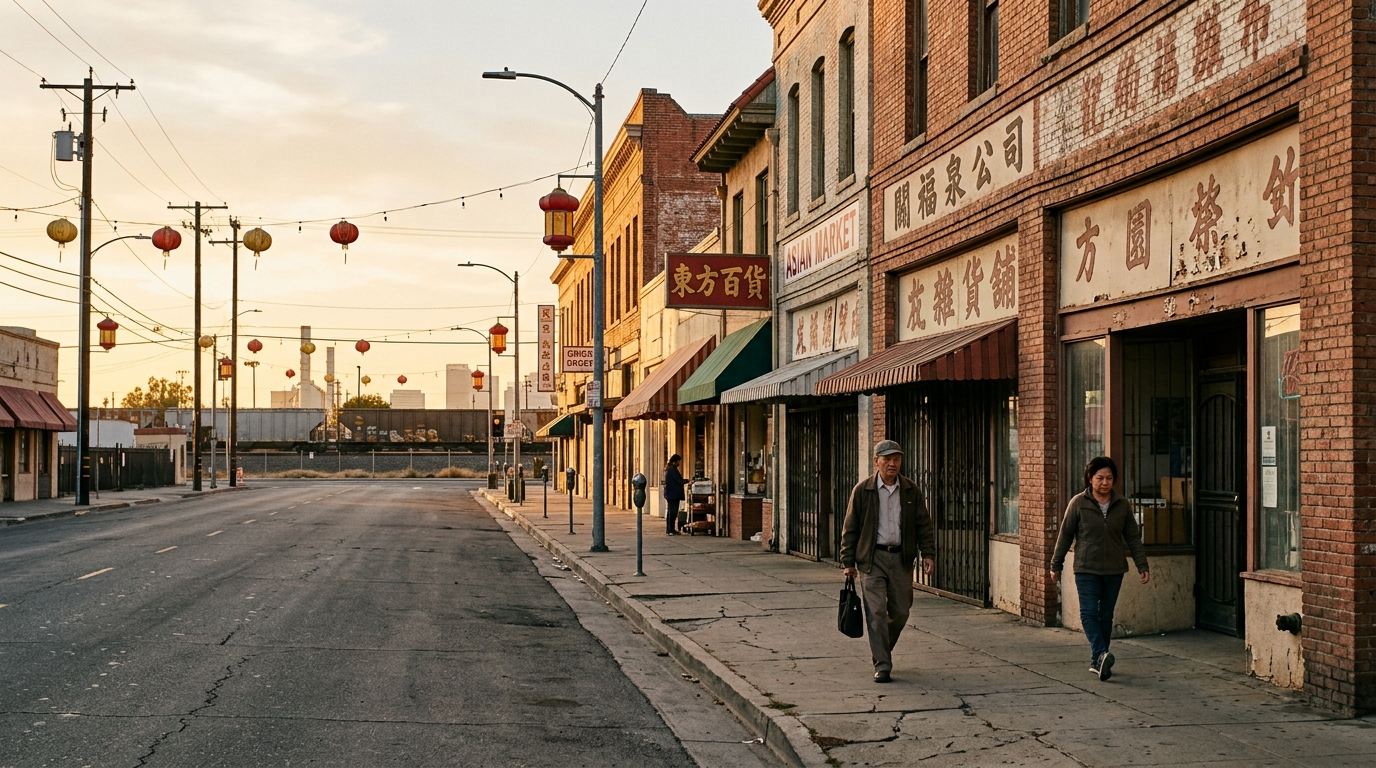
Fresno’s Chinatown is once again at the center of an important conversation about history, redevelopment, and the future of downtown. In 2026, the City of Fresno approved a new professional historic-resource survey for Chinatown, creating an opportunity to revisit a district whose story reaches back to the city’s earliest years. At the same time, new housing and revitalization proposals are bringing fresh attention to the neighborhood.
That combination makes Chinatown one of the most timely local-history topics in Fresno today. The district is not simply a collection of old buildings. It reflects the growth of the railroad city, immigration to the Central Valley, discriminatory settlement patterns, small-business development, cultural exchange, and repeated cycles of redevelopment. Understanding those layers matters as Fresno decides what should be preserved, documented, restored, or reimagined.
For readers exploring the broader story of the city, our Fresno Timeline provides additional context for how railroad expansion, population growth, agriculture, and neighborhood development shaped Fresno over time.
Why Fresno Chinatown Is Back in Focus
In May 2026, Fresno approved a consultant agreement for a comprehensive new historic survey of Chinatown. The work is intended to update and expand the earlier 2005–2006 research, address gaps in the historical record, broaden the study area, evaluate historic buildings, and help determine whether parts of Chinatown may qualify for historic-district recognition. The project is expected to continue through July 2028.
The timing is significant. Chinatown is also part of a larger conversation about downtown investment and housing. In July 2026, Fresno authorized an application for federal PRO Housing funding that could support mixed-income housing in Chinatown. That means preservation questions are no longer theoretical. Decisions about buildings, streets, development sites, and neighborhood character could shape what Chinatown looks and feels like for decades.
A Neighborhood Rooted in Railroads, Migration, and Exclusion
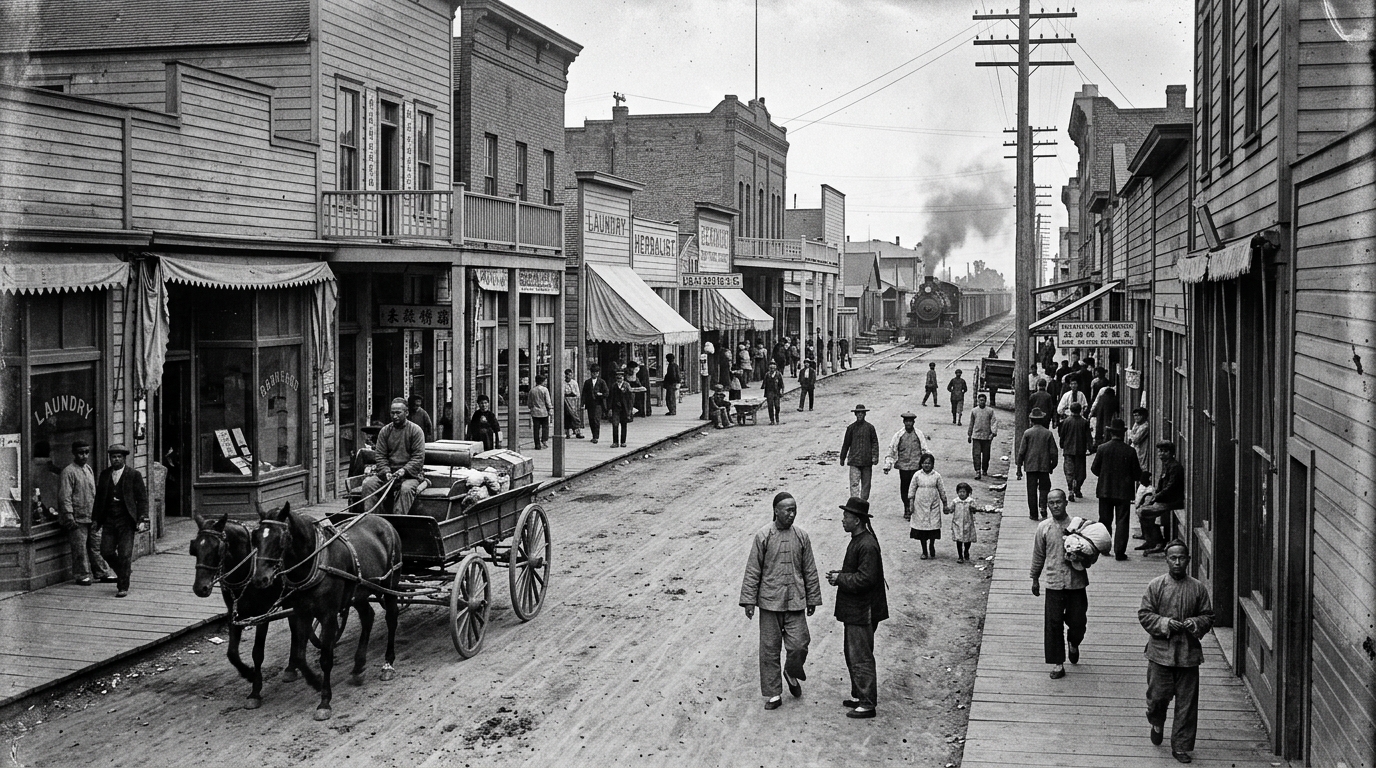
Fresno itself was founded as a railroad town in 1872. The Southern Pacific railroad corridor became one of the strongest organizing features of the young city, influencing where businesses, homes, warehouses, and ethnic communities developed. Chinese residents were present in Fresno from the beginning, but discriminatory social and racial restrictions pushed many Chinese residents and businesses to the area south and west of the railroad tracks.
That area became known as Chinatown. Historic research prepared for Fresno describes a dense neighborhood around streets including G, F, Mariposa, Kern, and Tulare. By the late nineteenth century, the district contained small shops, lodging houses, entertainment spaces, restaurants, service businesses, and other establishments serving residents who were often excluded from opportunities elsewhere in the city.
The Railroad Divide Shaped Early Chinatown
The railroad was both an economic engine and a social boundary. It brought workers, travelers, freight, and commercial opportunity to Fresno, but it also helped create a physical divide between downtown’s expanding commercial center and neighborhoods where marginalized communities were concentrated. Historic maps show Chinatown becoming densely developed surprisingly early in Fresno’s history.
This is one reason the neighborhood deserves to be understood as more than a collection of individual properties. Its significance comes from patterns: where people were allowed to live, how businesses clustered together, how immigrants built community institutions, and how those patterns changed as Fresno expanded. Readers can explore other places where architecture and community history intersect on our Historic Neighborhoods page.
A Multicultural District Grew South of the Tracks
Although the name “Chinatown” emphasizes the district’s Chinese origins, the neighborhood’s history became increasingly multicultural. Japanese immigrants also settled in the area as Fresno grew, particularly while anti-Asian discrimination restricted housing and commercial opportunities elsewhere. Other communities used nearby parts of the downtown and railroad corridor as entry points into Fresno’s economic life.
Over generations, restaurants, hotels, stores, entertainment venues, religious spaces, boarding houses, and family businesses gave the district a character distinct from the more formal commercial streets north of the tracks. Some structures disappeared. Others were altered. Some survived but lost the businesses or communities that originally gave them meaning.
That is why historic preservation is not only about attractive architecture. A modest building can matter because of the events, people, migration patterns, or cultural traditions associated with it. Our Notable People section looks at a related part of this story: the individuals whose work, businesses, creativity, and community leadership helped shape Fresno.
What the 2026 Historic Survey Will Examine
A professional historic survey gives planners and preservationists a structured way to identify what survives and why it may matter. Fresno’s earlier Chinatown Historic Resources Survey, completed in 2006, examined the six-block historic core and documented buildings within the neighborhood. Twenty years later, conditions have changed enough that an updated survey can provide a much clearer baseline.
The 2026 project is expected to expand on that earlier work rather than simply repeat it. Historic-resource surveys typically combine field observation, archival research, historic maps, photographs, property records, architectural analysis, and historical context. The result can help identify individual resources, groups of related buildings, potential districts, and places whose significance may come from cultural history rather than monumental architecture.
Updating Two Decades of Preservation Research
Two decades can dramatically change a historic neighborhood. Buildings may be demolished, rehabilitated, neglected, or heavily modified. New research can also change how historians interpret older resources. Communities that were underrepresented in earlier studies may receive more attention, while new archival discoveries can reveal connections that were previously undocumented.
For Fresno Chinatown, an updated survey can also clarify the boundaries and character of a potential historic district. That does not automatically freeze the neighborhood in time or prevent new development. Instead, it creates better information for evaluating future proposals. A well-documented district allows the city, property owners, developers, and community members to understand which features carry historical significance before irreversible decisions are made.
Historic photographs are especially valuable in that process because they show buildings in context. Compare changing streetscapes and community life through our Photo Archive, where images can help reveal details that written records sometimes miss.
What Preservation Could Mean for Chinatown’s Next Chapter
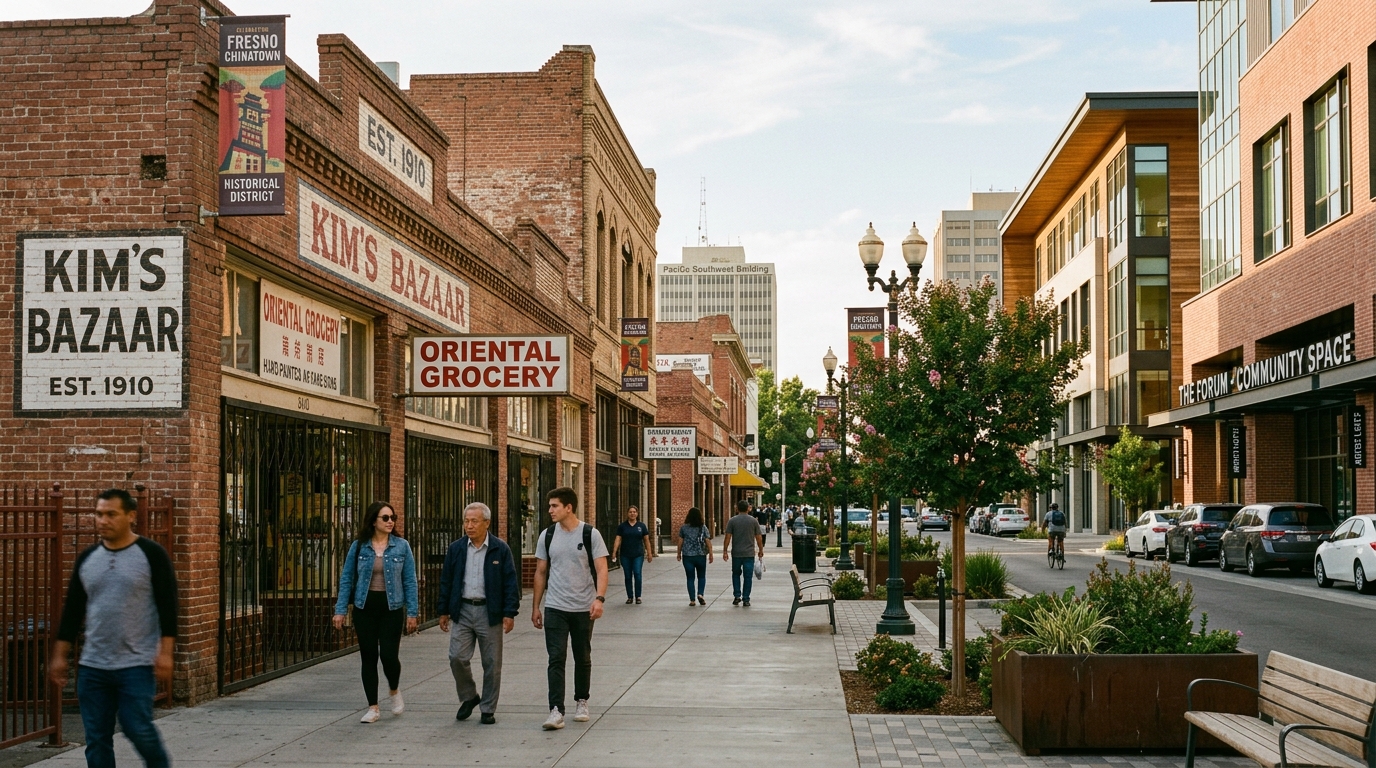
Preservation and redevelopment are often presented as opposing goals, but successful historic districts frequently depend on both. Empty or deteriorated buildings do not preserve history simply by remaining untouched. Reuse, rehabilitation, new housing, public improvements, and small-business investment can all strengthen a historic neighborhood when they respect its scale and identity.
Fresno already recognizes preservation as part of downtown revitalization. The city maintains a historic-resource program and has designated hundreds of individual resources, along with several local historic districts. Chinatown presents a more complex challenge because its historical value includes architecture, archaeology, ethnic settlement, commerce, displacement, and the changing relationship between the neighborhood and downtown.
Balancing New Housing and Historic Identity
The pressure to add housing downtown makes this conversation especially current. New residents can support restaurants, shops, transit, cultural organizations, and street activity. At the same time, redevelopment can erase the physical clues that make a neighborhood historically legible if projects are planned without understanding what came before.
The strongest outcome would not be to treat Chinatown as an outdoor museum. It would be to make its history visible while allowing the neighborhood to function as a living part of Fresno. That can mean rehabilitating viable historic buildings, incorporating older structures into new projects, interpreting vanished landmarks, improving pedestrian connections, supporting culturally relevant businesses, and documenting resources that cannot be saved.
Why Documentation Matters Before Redevelopment
Documentation becomes critical when preservation is not possible. Historic photographs, measured drawings, oral histories, maps, archaeological records, and written research can preserve information about a site even when the physical structure changes. This is especially important in neighborhoods that have experienced repeated displacement or demolition, because every loss can make the larger community story harder to reconstruct.
Fresno’s 2026 survey therefore matters beyond the question of whether a particular building receives a historic designation. It is an opportunity to create a stronger public record of Chinatown and to identify the places that best communicate its history. The City of Fresno’s Historic Preservation program provides additional information about local registers, historic surveys, designated resources, and preservation policy.
Visitors
Visitors interested in Fresno’s built heritage can also browse our Historic Landmarks guide for more places connected to the city’s architectural and civic development.
Chinatown’s future will be shaped by decisions being made now, but those decisions are stronger when they begin with an accurate understanding of the past. The new survey, current housing discussions, and renewed interest in downtown create a rare moment when historical research can directly influence how Fresno grows.
For a neighborhood created through the forces of railroads, migration, exclusion, entrepreneurship, and cultural resilience, that attention is overdue. Preserving Chinatown does not require choosing the past instead of the future. It requires making sure the future still has enough of the past to understand where Fresno came from.