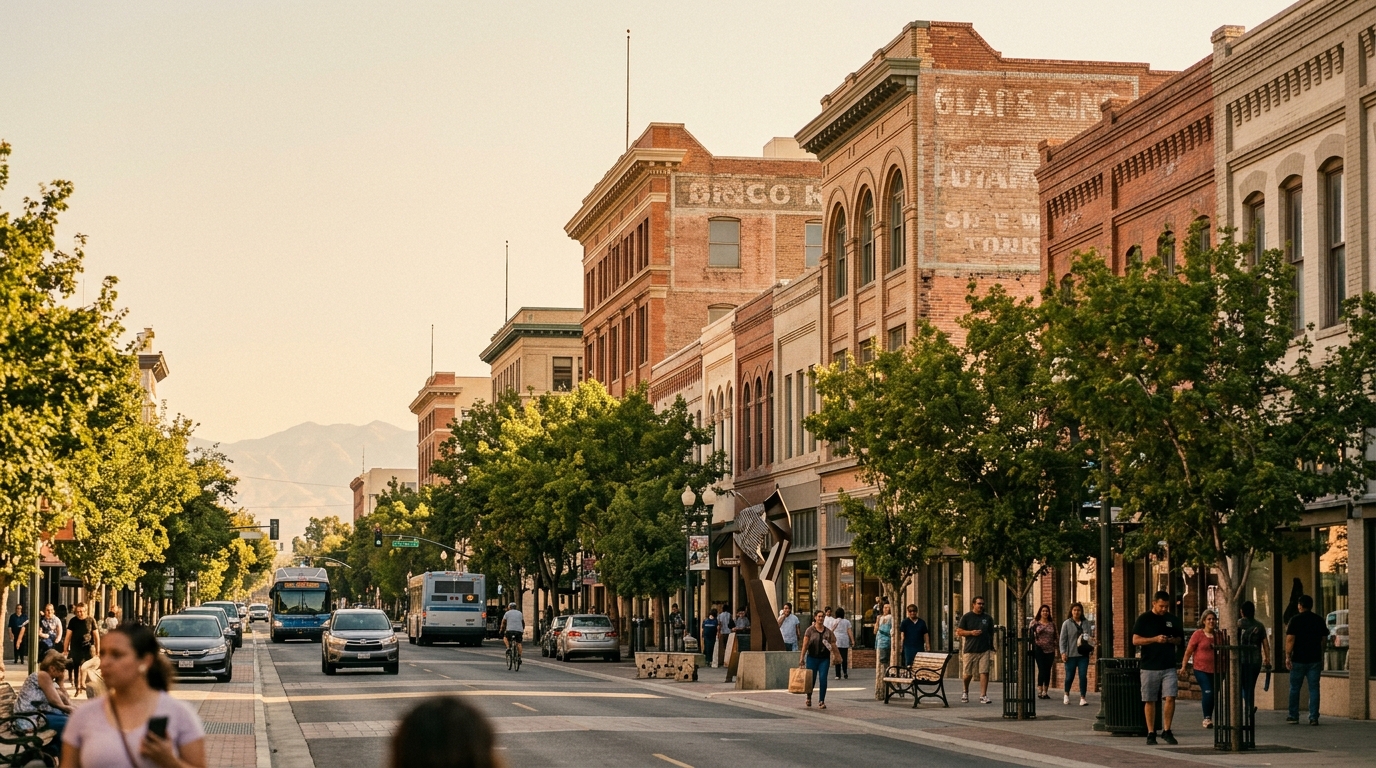
Downtown Fresno is entering another important chapter. In 2026, the Downtown Fresno Partnership and Downtown Fresno Foundation are advancing a 2026–2032 strategic planning effort focused on making the city center more vibrant and economically active. The plan arrives as downtown has visible momentum but also persistent challenges, including vacant storefronts, underused buildings, and uneven private investment.
What makes the current conversation especially important for a history site is the role of Fresno’s older buildings. The strategic plan describes downtown as the place where historic buildings and cultural landmarks tell the story of Fresno’s past while also helping shape its future. That idea connects economic development with preservation rather than treating them as separate goals.
For Fresno, this is not simply about saving attractive facades. Downtown contains layers of railroad history, commerce, theaters, offices, hotels, warehouses, and public art that document how the city grew. Readers can place these changes in context through our Fresno Timeline and Historic Landmarks page.
Why Historic Buildings Matter to Downtown Fresno’s 2026–2032 Revitalization
The current strategic planning effort recognizes progress made during the previous decade. Fulton Street reopened to vehicle traffic, ArtHop expanded, new restaurants and small businesses appeared, and downtown events returned. Yet the Downtown Fresno Partnership also points directly to a continuing problem: too many storefronts remain vacant and investment still falls short of downtown’s potential.
Historic buildings sit at the center of that challenge. A vacant older building can signal decline, while the same structure can become a major asset when repaired and adapted for housing, restaurants, offices, shops, or cultural uses. Successful reuse can create places that feel distinctly Fresno instead of interchangeable with newer development.
Fresno’s Downtown Identity Was Built Over Generations
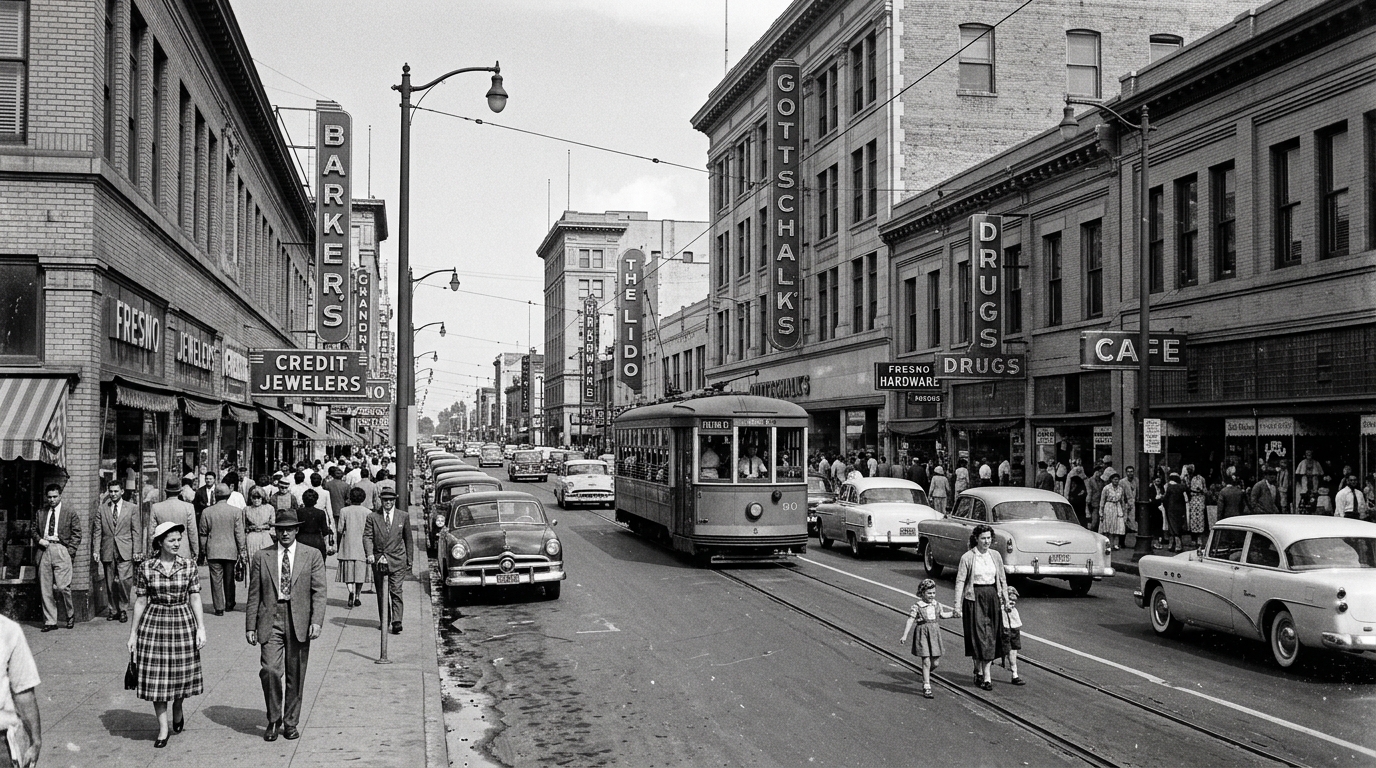
Downtown Fresno grew from railroad-era origins into a commercial, civic, and entertainment center of the Central Valley. Historic storefronts, theaters, office towers, hotels, warehouses, and public buildings reflect different periods of growth and reveal how people worked, traveled, shopped, and gathered.
This accumulated character is difficult to recreate once lost. That is why Fresno’s earlier planning documents treated preservation as a core revitalization strategy. The Fulton Corridor Specific Plan, adopted in 2016, identified historic preservation as a critical component of revitalization and emphasized downtown’s unique collection of older buildings.
Fulton Street Shows How Downtown Has Already Been Reimagined
Fulton Street is one of the clearest examples of downtown Fresno changing while retaining pieces of its past. The original street was converted into a pedestrian mall in 1964. After decades of changing retail patterns and declining activity, Fresno reconstructed the corridor and reopened it to vehicle traffic in October 2017 for the first time in more than 50 years.
The project did more than add lanes and parking. The City of Fresno reported that all 32 public art pieces along the corridor were conserved, restored, and returned, while fountains and landscaping were also incorporated into the redesigned street. The result demonstrates an important preservation lesson: revitalization does not always require choosing between the old city and the new city. Sometimes the stronger approach is to redesign how a historic place works while carrying forward the elements that make it recognizable.
Historic images of Fulton Street and other changing downtown blocks can also be valuable for understanding what survives today. Visit our Photo Archive to compare Fresno streets, architecture, and community life across different eras.
Vacancy Is Both an Economic and a Preservation Problem
Empty historic buildings face risks that occupied buildings often do not. Deferred maintenance can lead to damaged roofs, failing systems, vandalism, and lost architectural features. Long-term vacancies also weaken surrounding blocks by reducing foot traffic and interrupting active storefronts.
That means preservation policy cannot focus only on preventing demolition. A successful strategy must also make reuse practical. Fresno’s downtown plans have long called for refurbishing and adaptively reusing existing buildings, introducing housing, supporting mixed-use development, and creating pedestrian-friendly streets. The current 2026–2032 effort builds on that broader goal of turning downtown into a place where people can live, work, spend time, and invest.
Adaptive Reuse Can Turn Old Buildings Into Working Assets
Adaptive reuse gives an older building a viable new purpose while retaining important historic features. A former office building might become apartments, a commercial building might mix retail with housing, and a warehouse might become creative or community space.
For downtown Fresno, this approach can address several goals at once. Reusing existing buildings can activate vacant properties, create housing or business space, preserve architectural character, and strengthen walkable blocks. It can also help keep investment concentrated in the existing urban core rather than requiring every project to begin with demolition and complete replacement.
Preservation Does Not Mean Freezing a Building in Time
One common misconception is that historic preservation requires a property to remain exactly as it appeared decades ago. In practice, rehabilitation is built around allowing useful change while protecting important historic features. The National Park Service describes rehabilitation as making efficient contemporary use possible while preserving the portions of a property that carry historic, architectural, or cultural value.
For qualifying income-producing historic buildings, the federal Historic Preservation Tax Incentives program can also help support rehabilitation. The program provides a 20 percent federal income tax credit for qualified rehabilitation expenses on certified historic structures when requirements are met. Projects must follow the Secretary of the Interior’s Standards for Rehabilitation, and not every property or expense qualifies. Property owners considering such a project should review the National Park Service Historic Preservation Tax Incentives program and obtain appropriate professional advice.
This kind of incentive matters because rehabilitation can be complicated. Older buildings may need seismic, accessibility, mechanical, fire-safety, and material repairs. Preservation works best when financing, technical expertise, and a realistic new use come together.
What a Preservation-Led Downtown Fresno Strategy Could Look Like
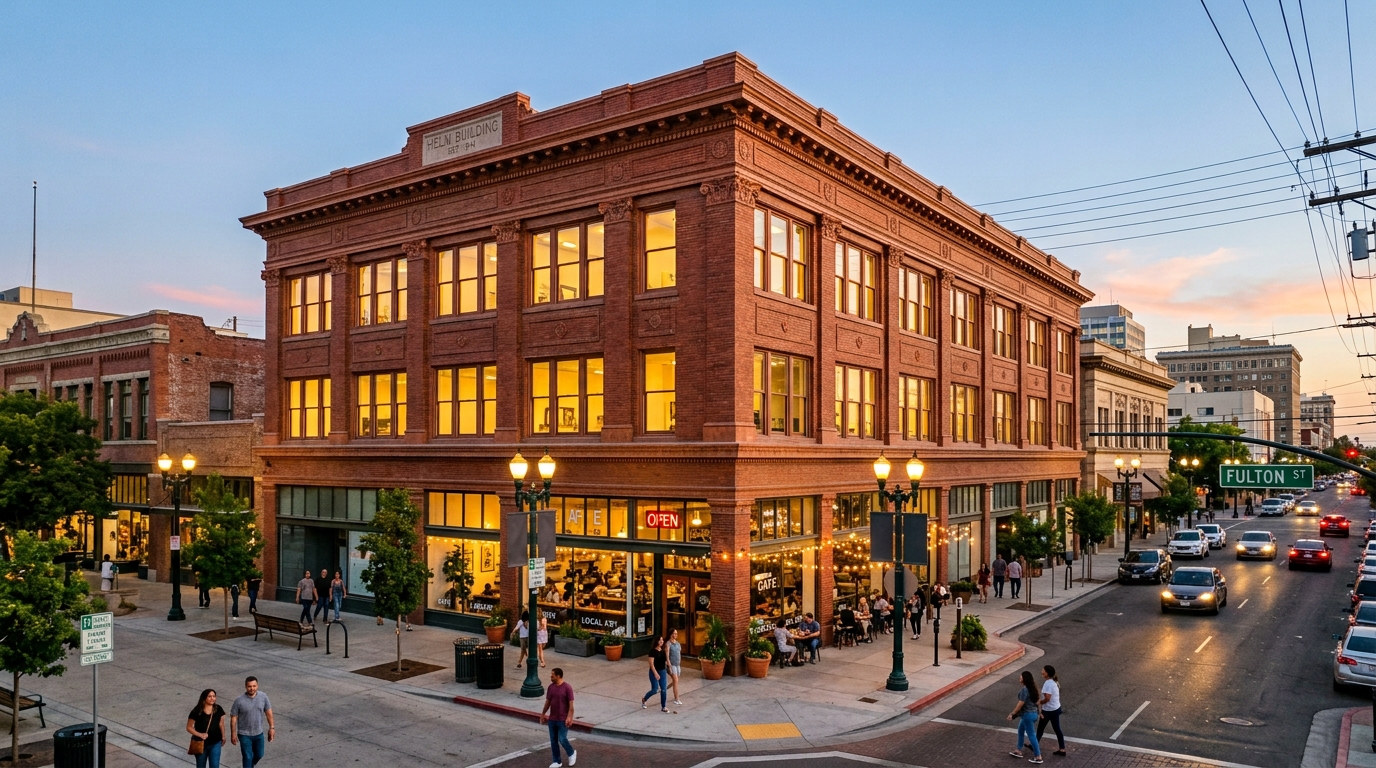
Fresno does not need to choose between preserving its past and adding the housing, businesses, services, and public spaces needed for the future. In fact, the city’s own downtown planning framework has repeatedly connected those goals. The General Plan directs growth and reinvestment toward the central core, while downtown plans emphasize adaptive reuse, mixed-use development, walkability, and preservation of traditional heritage.
The city also continues to push housing production in and around downtown. Fresno’s revitalization strategy notes that more than 600 apartments have been added in recent years and describes a long-term goal of substantially increasing the downtown residential population. More residents can support shops, restaurants, cultural venues, transit, and street activity, but the quality of that growth matters. A downtown filled only with disconnected new projects could become more populated without becoming more distinctive.
Growth, Housing, and Heritage Can Share the Same Blocks
A stronger model combines new construction with rehabilitation and thoughtful infill. New buildings can fill vacant lots while respecting the scale and pedestrian character of surrounding blocks, while public spaces can interpret vanished landmarks through photographs, plaques, or public art.
The same principle applies beyond the central commercial core. Downtown’s future is connected to nearby communities, including Chinatown and other established neighborhoods whose histories are tied to railroads, migration, housing, and commerce. Our recent article on Fresno Chinatown’s new preservation era explains why documentation and redevelopment must move together when historic districts are experiencing renewed investment.
Preservation can also support local storytelling. A reused theater, hotel, department store, or office building gives residents a physical connection to earlier generations. When those buildings stay active, history becomes part of everyday life rather than something encountered only in an archive.
The Best Revitalization Keeps Fresno Recognizable
The real test of downtown revitalization is not simply how much money is invested or how many projects are completed. It is whether the result creates a stronger city center that still feels connected to Fresno. Historic buildings and cultural landmarks provide that continuity. They show how the city moved from a railroad settlement to an agricultural and commercial center, how downtown adapted to changing transportation and retail patterns, and how different generations left their mark on the same streets.
The 2026–2032 strategic planning effort arrives at a useful moment. Downtown has seen progress, but vacancies and underinvestment remain visible. Fresno now has an opportunity to treat older buildings as assets that can make redevelopment more memorable and rooted in place.
That does not mean every old structure can or should be preserved. Building condition, significance, safety, feasibility, and community priorities all matter. But decisions should begin with good information and a clear understanding of what may be lost. Our Historic Neighborhoods section explores how buildings and streets work together to preserve that larger sense of place.
Downtown Fresno’s strongest future may come from a simple idea: use new investment to bring old places back into active life. If housing, business growth, public improvements, adaptive reuse, and historic preservation reinforce one another, the city center can become more economically useful without becoming historically anonymous. That would make revitalization not just a development strategy, but the next chapter in Fresno’s continuing history.