
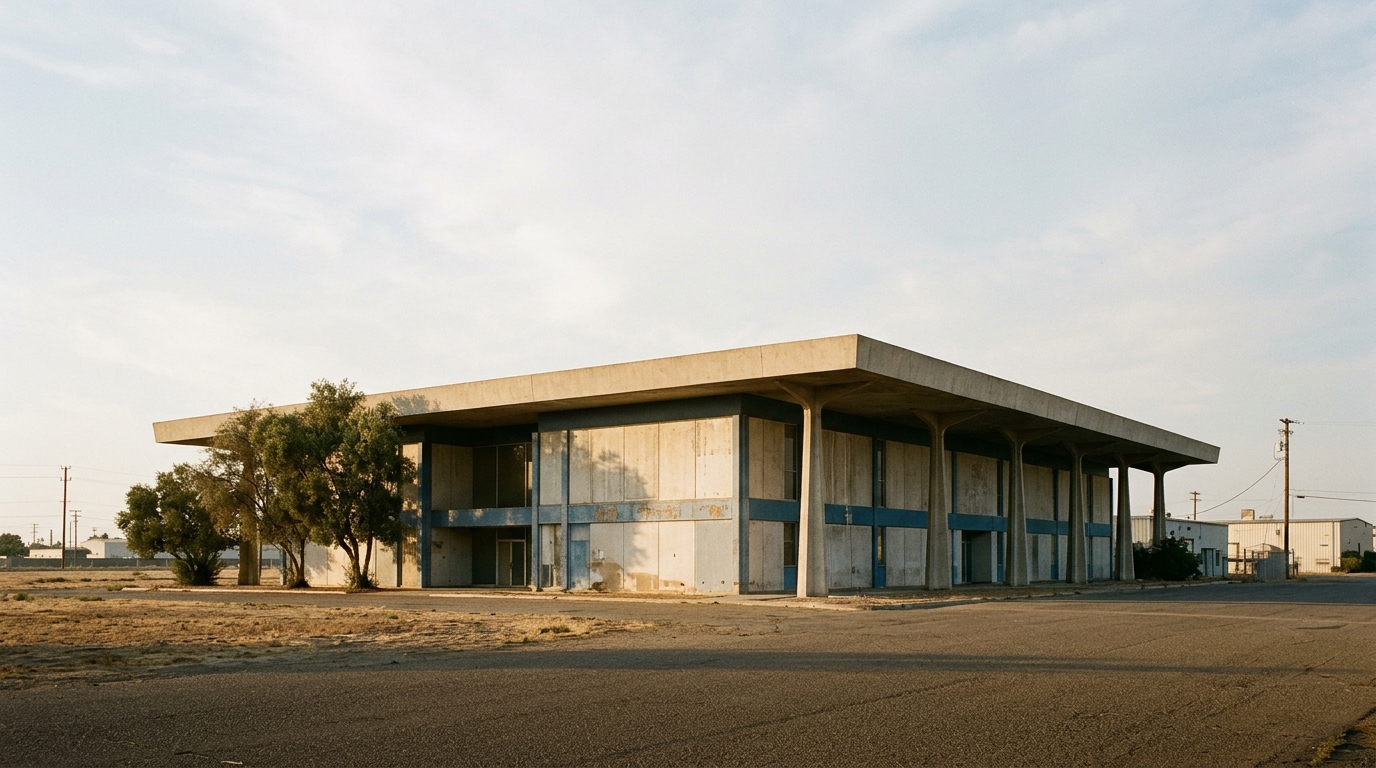
One of Fresno’s most consequential historic-building debates of 2026 is unfolding at 1626 E Street, where the former Fresno Bee printing and production plant is proposed for demolition. The massive complex west of Downtown Fresno is not the newspaper’s original 1922 headquarters. Instead, it represents a later chapter in the city’s history: postwar urban renewal, regional mass media, industrial-scale newspaper production, and the changing relationship between downtown Fresno and surrounding neighborhoods.
The City of Fresno has owned the property since 2021. After a catastrophic failure of the building’s central air-conditioning system in June 2025, officials concluded that major portions were no longer practical for city office use. By early 2026, Fresno was preparing for demolition, triggering a historic-resource evaluation as the oldest portions had crossed the 50-year preservation threshold.
The 2026 historic-resource evaluation found the Fresno Bee Plant significant for its association with urban renewal and communications in the Central Valley, even though it was not considered one of Fresno’s strongest examples of its architectural style. Our Fresno Timeline provides broader context for this era.
Why the Former Fresno Bee Plant Matters to Fresno History
Construction of the Fresno Bee Plant began in 1968 on E Street, in an industrial and commercial corridor between Highway 99 and the Southern Pacific railroad tracks. The first phase created a roughly 100,000-square-foot facility designed around newspaper production, including the printing press, newsprint storage, newsroom functions, and facilities connected with the Bee’s broader media operations.
A second phase in 1973 added offices, a lobby, executive spaces, and other facilities. A major 1990 expansion nearly doubled the original complex. By then, the property had become an industrial-scale media facility reflecting the physical demands of producing and distributing a daily newspaper before digital publishing transformed the industry.
From the 1922 Bee Building to a Modern Printing Complex
The E Street plant makes more sense when viewed alongside the Fresno Bee’s earlier home. The newspaper was established in 1922 by Charles Kenney “C.K.” McClatchy and Valentine Stuart “V.S.” McClatchy. Its original six-story building stood at Van Ness Avenue and Calaveras Street in Downtown Fresno and was designed by architect Leonard F. Starks. That earlier building survives and is listed in the National Register of Historic Places.
The move to E Street represented a different phase of newspaper history. The later plant was designed for presses, paper storage, distribution, staff, and related media functions, showing how newspapers evolved into complex regional production systems.
The Building Recorded the Physical Era of Daily News
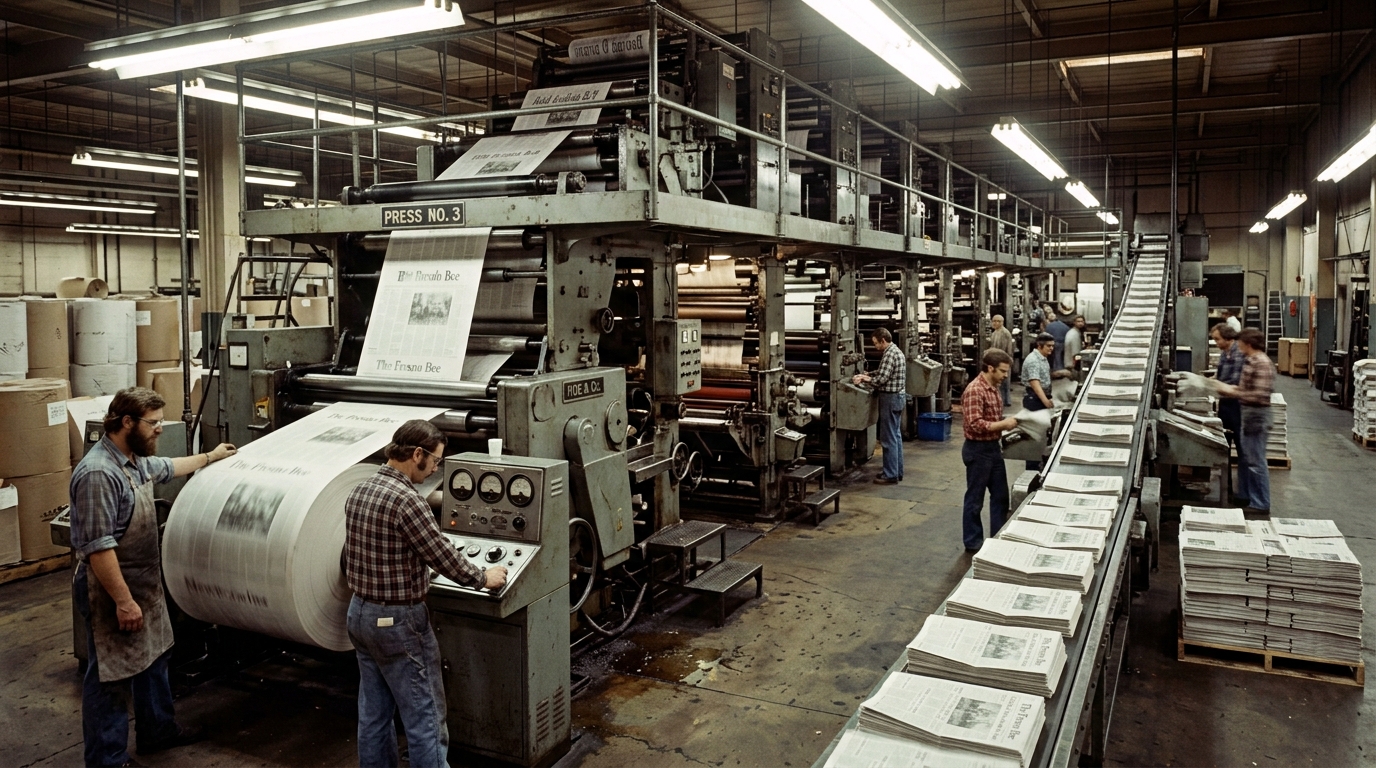
Before online news and smartphones, producing a metropolitan newspaper required enormous infrastructure. Stories had to be printed at high speed, bundled, loaded, and transported throughout the region. The E Street facility existed because news was a physical product moving through an industrial process every day.
City historic-review documents also connect the plant with the Bee’s broader communications operations, helping explain why evaluators identified communications in the Central Valley as one of the property’s significant historic themes. That history belongs alongside the people who shaped Fresno’s civic and cultural life, many of whom are featured in our Notable People section.
The Site Was Also Part of West Fresno Urban Renewal
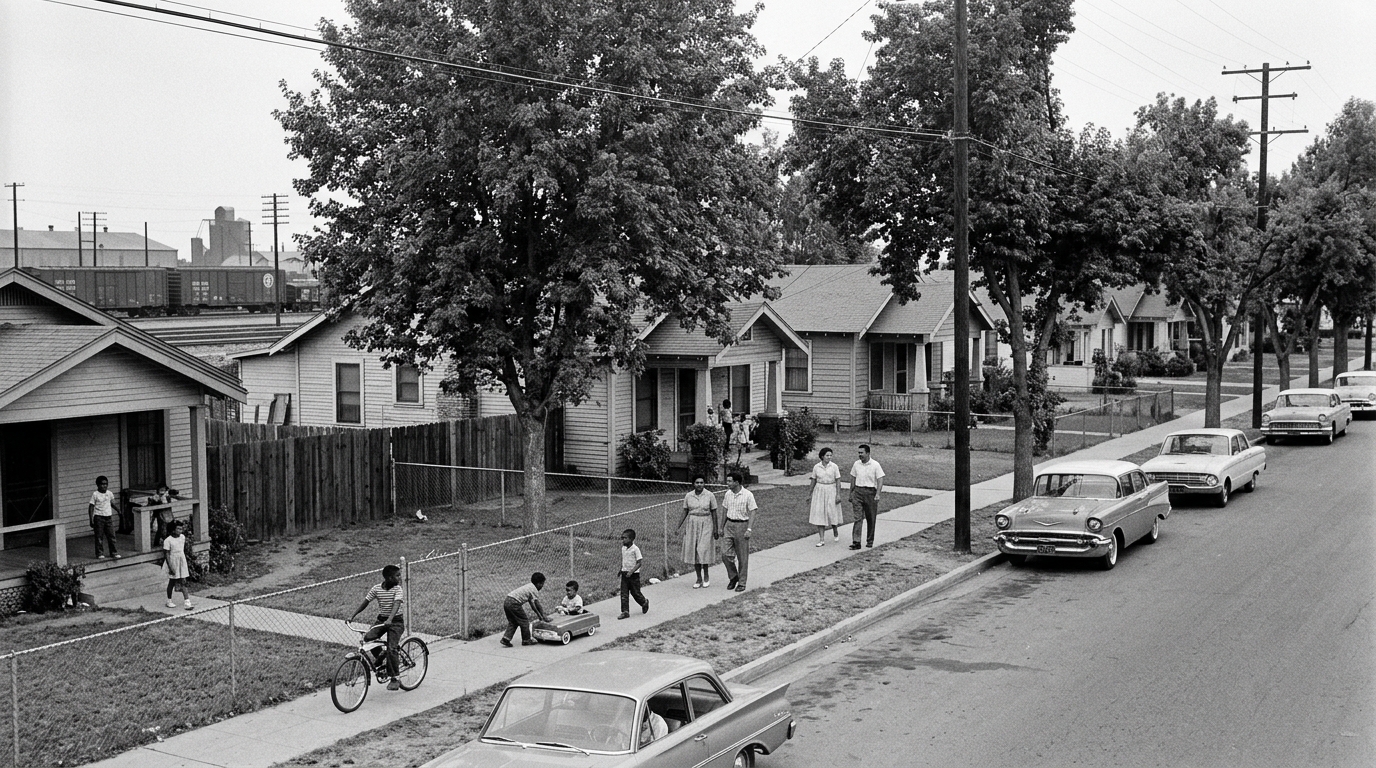
The history of 1626 E Street is not limited to journalism. The plant was the first project developed as part of the West Fresno I redevelopment plan, a federally approved urban-renewal program. Before redevelopment, the site contained single-family homes that were cleared after being characterized as uninhabitable. The McClatchy Company then acquired the site for the new Bee facility.
That history makes the property more complicated. Urban-renewal programs were promoted as tools for removing deteriorated conditions and attracting investment, but they also displaced residents and erased existing neighborhoods in cities across the United States. Fresno’s historic-resource report treats the Bee Plant as important evidence of that urban-renewal period.
The report describes the plant as the most successful project in the West Fresno Phase I redevelopment area in terms of early property-tax revenue gains. That success does not erase the residential landscape that came before it. Explore related context in our Historic Neighborhoods section.
Why a Historically Significant Building Can Still Face Demolition
By the 2010s, newspaper production had changed dramatically. Printing was moved away from Fresno, and the Bee eventually left the E Street complex. The City of Fresno purchased the property in April 2021 for Department of Public Utilities operations.
The challenge was scale. City records describe a 14.84-acre property with a building totaling about 295,000 square feet after decades of expansion. Only a small portion was being used for offices, while other areas served storage and overflow functions. Operating such a large specialized facility became increasingly difficult.
A 2025 Systems Failure Changed the Building’s Future
On June 23, 2025, the building’s central air-conditioning system failed catastrophically and could not be restored. City staff relocated employees and reconsidered planned improvements. By January 2026, officials were moving toward demolition rather than investing further in a building they considered too expensive and inefficient for their needs.
The April 2026 evaluation found the property eligible for the California Register of Historical Resources under Criterion 1 because of its association with important events. The identified themes were urban renewal in Fresno, with a period of significance from 1969 to 1973, and communications in the Central Valley, with a period of significance from 1969 to 1981.
At the same time, the evaluation did not find the building significant for association with important individuals or as an outstanding work of architecture. It identified the design as New Formalism and noted surviving features such as projecting roof slabs, distinctive columns, louvered panels, aluminum-framed glazing, and original cladding materials. Evaluators concluded that other Fresno buildings were stronger examples of the style.
What Fresno Can Preserve When the Building Itself May Not Survive
On April 27, 2026, Fresno’s Historic Preservation Commission considered whether the E Street property should move toward local historic designation. City staff recommended against initiating designation, and the commission recommended denial. That action did not mean the site had no history. The technical report documented substantial significance connected to events that shaped Fresno.
The distinction matters. Preservation decisions involve more than whether a building is old. Officials consider significance, integrity, condition, feasibility, and future use. The California Office of Historic Preservation explains that the California Register recognizes resources tied to significant events as well as architecture, important people, and archaeological information.
Documentation Can Become a Form of Preservation
When a historic building cannot be retained, documentation becomes especially important. Photographs, architectural drawings, oral histories, newspaper records, maps, artifacts, and interpretive exhibits can preserve information that would otherwise disappear with the structure. They cannot fully replace a surviving building, but they can prevent demolition from becoming historical amnesia.
City staff suggested mitigation measures that could interpret the Bee Plant’s history after demolition. One possibility identified in the 2026 report was a permanent display explaining the site’s relationship to the Fresno Bee, communications history, and urban renewal. Such an exhibit could potentially be housed at the original Fresno Bee building on Van Ness Avenue or at the Fresno Republican Printery.
Historic Photographs Become More Valuable After a Place Is Gone
Photographs preserve details that written descriptions rarely capture: the scale of a printing hall, machinery, workers, delivery vehicles, and the relationship between the complex and its surroundings. Our Photo Archive uses that same principle to document places that have changed or disappeared.
The E Street plant also demonstrates why surveys should happen before demolition is imminent. Research can document character-defining features, alterations, and historical associations while the property still exists. Once a complex is removed, researchers are limited to surviving records.
There is also a lesson for Fresno’s current redevelopment efforts. Our article on Downtown Fresno revitalization and historic buildings examines how adaptive reuse can give older properties new purposes when rehabilitation is feasible. The Bee Plant shows the other side of that equation: some enormous, highly specialized buildings are much more difficult to reuse economically.
Fresno Bee Plant
If demolition proceeds, the physical Fresno Bee Plant may disappear from E Street, but its history should not. The property links several major stories: the transformation of newspaper production, the growth of regional media, postwar architecture, public redevelopment policy, displacement in West Fresno, and the decline of industrial newspaper printing in the digital age.
Historic preservation is not only about saving every structure. It is also about deciding which stories a city recognizes, what evidence it preserves, and how future residents will understand places that no longer exist.
The former Fresno Bee Plant may become an example of history preserved primarily through research rather than bricks and concrete. If Fresno documents the complex carefully, interprets the urban-renewal story honestly, preserves photographs and records, and connects the E Street plant with the surviving 1922 Bee building, the city can retain an important part of the story even after the landscape changes. What disappears physically does not have to disappear from Fresno’s memory.