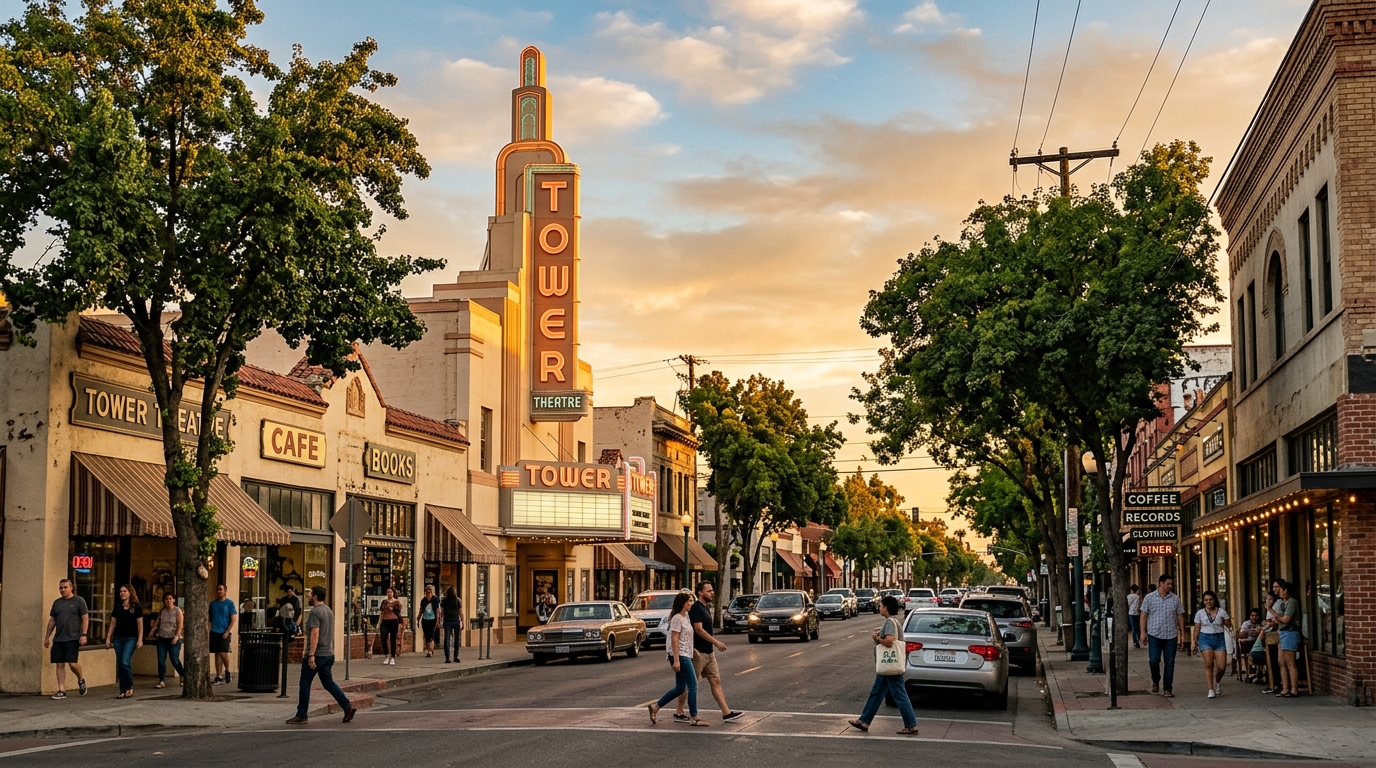
Few Fresno neighborhoods have an identity as immediately recognizable as the Tower District. Its historic homes, apartment courts, neighborhood businesses, mature trees, entertainment venues, and walkable streets reflect more than a century of growth. In 2026, protecting that character has become especially timely because Fresno is beginning to implement a newly updated Tower District Specific Plan.
The Fresno City Council adopted the updated plan and accompanying design standards in November 2025, replacing a planning framework that dated back to 1991. The new plan does much more than regulate future construction. It calls for updated historic surveys, a comprehensive historic context statement, renewed evaluation of potential historic districts, and stronger recognition of cultural histories that earlier preservation efforts may have overlooked.
For anyone interested in Tower District historic preservation, the changes could shape how Fresno identifies important properties and manages development for years. Readers interested in the larger evolution of the city can also explore our Fresno Timeline and Historic Neighborhoods resources.
Why the Tower District Is So Important to Fresno History
The Tower District did not begin as the dense urban neighborhood familiar to Fresno residents today. In the early twentieth century, much of the area was at or beyond the developed edge of the city. Streetcar expansion helped transform that landscape into one of Fresno’s earliest suburban districts.
The Fresno Traction Company extended streetcar service from Downtown Fresno into the area, making it easier for residents to live outside the commercial center while continuing to travel into downtown. Homes, apartment buildings, and neighborhood businesses followed those transportation routes. Over time, the district became denser and more architecturally varied.
From Streetcar Suburb to Cultural Center
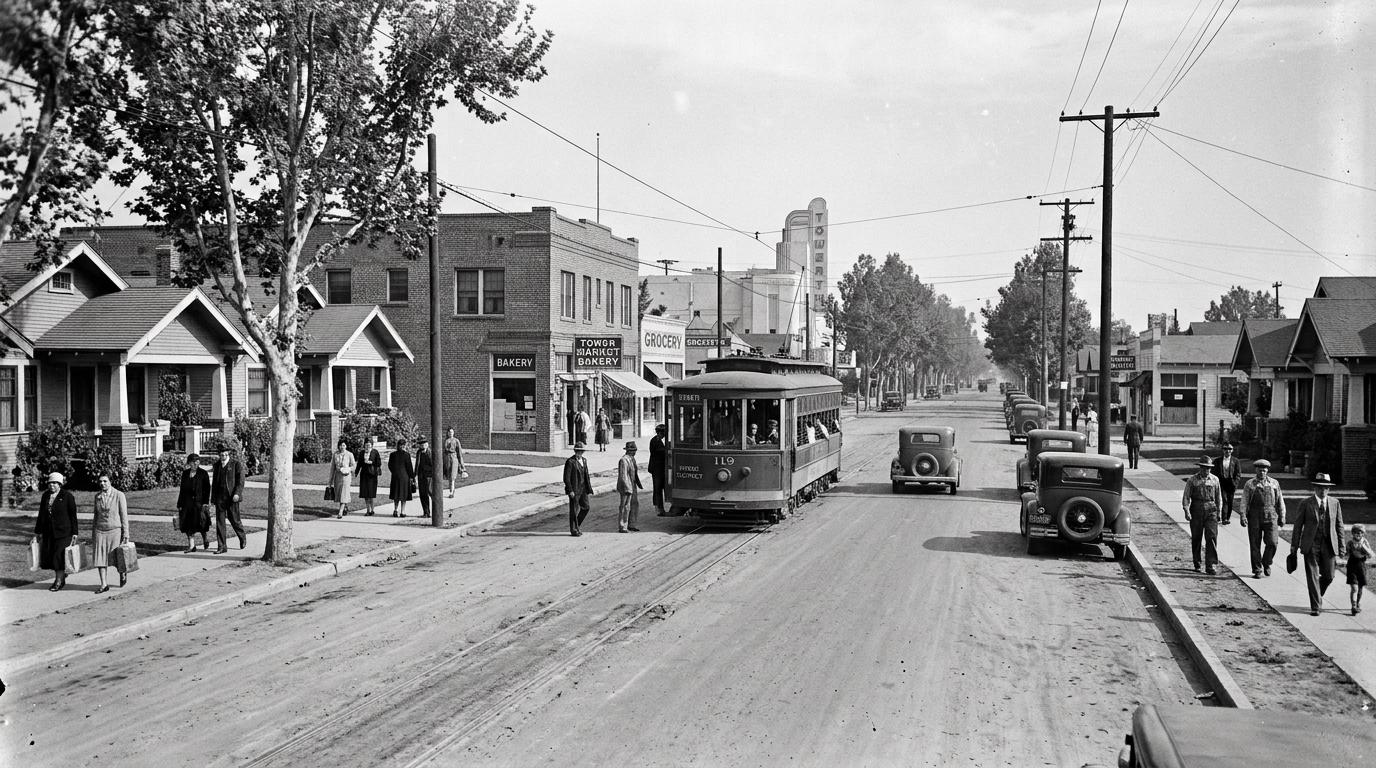
Fresno’s current planning documents describe the Tower District as a longstanding example of a pre-World War II streetcar suburb. Its development produced a mix of small bungalows, larger homes, apartment houses, courtyard housing, and street-facing commercial buildings. That variety remains one of the neighborhood’s defining qualities.
The district continued changing after the streetcar era. Commercial corridors evolved, older homes were renovated, restaurants and independent businesses arrived, and the neighborhood became associated with arts, nightlife, events, and cultural life. The result is a place where residential streets and commercial activity remain closely connected.
Historic Character Comes From More Than Famous Buildings
The value of the Tower District is easy to associate with prominent landmarks, but preservation planners increasingly look at entire patterns of development. A modest bungalow, apartment court, tree-lined street, or group of compatible storefronts may help explain neighborhood history even when no single structure is monumental.
The City’s earlier 1991 survey focused heavily on this idea. It documented not only individual historic properties but also characteristic building arrangements and neighborhood patterns from the first decades of the twentieth century. Those resources still help explain how the district evolved.
Visitors can explore individual examples of Fresno’s architectural heritage through our Historic Landmarks section, but understanding the Tower District requires looking at buildings collectively as part of a larger historic landscape.
Older Buildings Still Serve Modern Neighborhood Needs
The updated Specific Plan makes another important point: preservation is not valuable only because older buildings look attractive. Existing buildings contribute economically and environmentally to the neighborhood. Reusing them can reduce demolition waste, encourage reinvestment, and retain commercial spaces with architectural details and dimensions that newer buildings may not reproduce.
The plan also notes that older buildings provide a significant share of the Tower District’s relatively affordable housing. This makes preservation more complicated than simply protecting decorative facades. Changes involving apartment buildings, bungalow courts, and other residential properties can affect both historic character and the people who live in the neighborhood.
The New Plan Calls for a Fresh Look at Tower District History
One of the most significant preservation proposals in the updated plan is the creation of a comprehensive historic context statement. A historic context explains how an area developed over a particular period and identifies the themes, people, events, architecture, and cultural patterns that make surviving places meaningful.
The National Park Service considers historic contexts a foundation of sound preservation planning because individual buildings can be evaluated more reliably when their relationship to other properties and larger historical patterns is understood. Fresno’s plan calls for this context work to involve professional research as well as community participation.
New Surveys Could Identify Resources Missed in Earlier Studies
The Tower District has already been studied extensively, but preservation data becomes outdated. Buildings change, properties are demolished, additional research becomes available, and standards for evaluating cultural significance continue to develop. The new plan therefore calls for updated historic-resource surveys to establish a new preservation baseline.
A 2025 environmental review conducted for the Specific Plan update identified 44 previously recorded historic resources within the plan area, including 40 historic structures. That figure does not necessarily represent every property that could eventually prove significant. One purpose of new surveys is to identify resources that previous studies did not fully recognize.
This matters because preservation practice has expanded beyond an earlier emphasis on architectural style and prominent individuals. The plan specifically directs the future historic context statement to address contributions by communities and people who may have been overlooked or marginalized in earlier histories, including women, communities of color, and Fresno’s LGBTQ+ community.
That approach could produce a richer historical record. A property may be significant because of community organizing, cultural activity, social history, or association with groups whose stories were not fully represented in earlier surveys. Our Notable People archive similarly explores how individual lives can reveal dimensions of Fresno history that buildings alone cannot tell.
What the Preservation Policies Could Mean for the Tower District’s Future
The updated plan is not designed to turn the Tower District into a museum. Fresno still needs housing, investment, businesses, transportation improvements, and new development. Instead, the preservation policies provide a framework for deciding where change can occur without unnecessarily erasing the qualities that make the neighborhood distinctive.
That balance is especially important in a desirable central-city neighborhood. Development pressure can improve vacant or underused properties, but incompatible projects may also alter building scale, streetscape rhythm, landscaping, and relationships between older structures.
Previously Proposed Historic Districts May Get Another Look
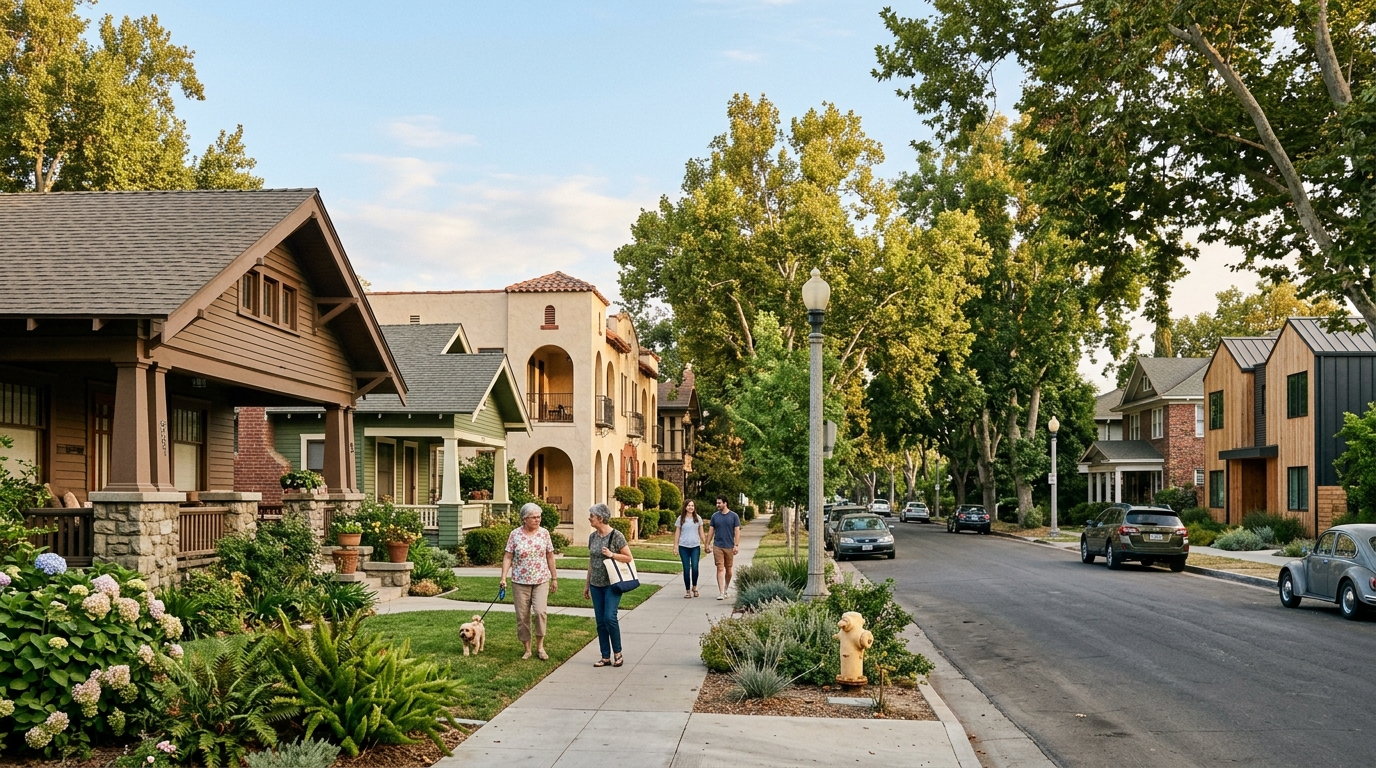
Perhaps the most interesting policy for local-history readers is the plan’s call to revive evaluation of several areas that were proposed as potential historic districts decades ago but never formally designated. The 1991 Specific Plan identified areas including Adoline-Palm, Terrace Gardens, Wilson’s North Fresno Tract, Lower Fulton-Van Ness, Bungalow Court, and additional areas around Olive, Van Ness, Elizabeth, San Pablo, Belmont, and Broadway.
The updated plan recommends prioritizing these locations for new surveys and evaluation. Formal designation is not automatic. Research would need to determine whether enough historic resources survive, whether they retain sufficient integrity, and whether the areas meet applicable designation criteria.
If some ultimately qualify, recognition could help Fresno better understand how entire blocks and subdivisions contributed to the city’s development. It could also give planners clearer information when evaluating future changes.
Compatible New Development Will Be Part of the Preservation Strategy
The plan also addresses what happens around historic properties. New buildings do not have to imitate older architecture, but their scale, placement, massing, streetscape relationship, and design can influence whether a historic neighborhood remains visually coherent. Fresno’s updated standards therefore emphasize context-appropriate infill and compatible public features such as lighting, trees, landscaping, and street furnishings.
This approach reflects broader preservation practice. The National Park Service Preservation Planning Guidelines explain that preservation planning should integrate historic-resource goals with other land-use priorities rather than treating preservation as an isolated activity.
Fresno has already encountered the same challenge downtown, where redevelopment must work alongside older architecture. Our article on Downtown Fresno revitalization and historic buildings looks at how adaptive reuse can turn historic properties into active economic assets rather than leaving them vacant.
Tower District’s
The Tower District’s new preservation framework is significant because the neighborhood is still alive and changing. People live in its older homes, operate businesses from historic storefronts, attend events, walk its streets, and continually reinterpret what the district means. Successful preservation must therefore protect history without preventing the neighborhood from evolving.
In 2026, Fresno has an opportunity to update not only a planning document but also its understanding of Tower District history. New surveys can reveal overlooked resources. A stronger historic context can document communities previously left out of the record. Renewed district evaluations can determine whether important concentrations of historic buildings still survive. Design standards can help new development become part of the neighborhood without overwhelming what came before.
The result will depend on implementation, research, community participation, and future development decisions. But the central idea is clear: the Tower District’s character did not appear accidentally. It was built over generations, and understanding that history gives Fresno a better chance of allowing the neighborhood to grow without losing the qualities that made it distinctive in the first place.