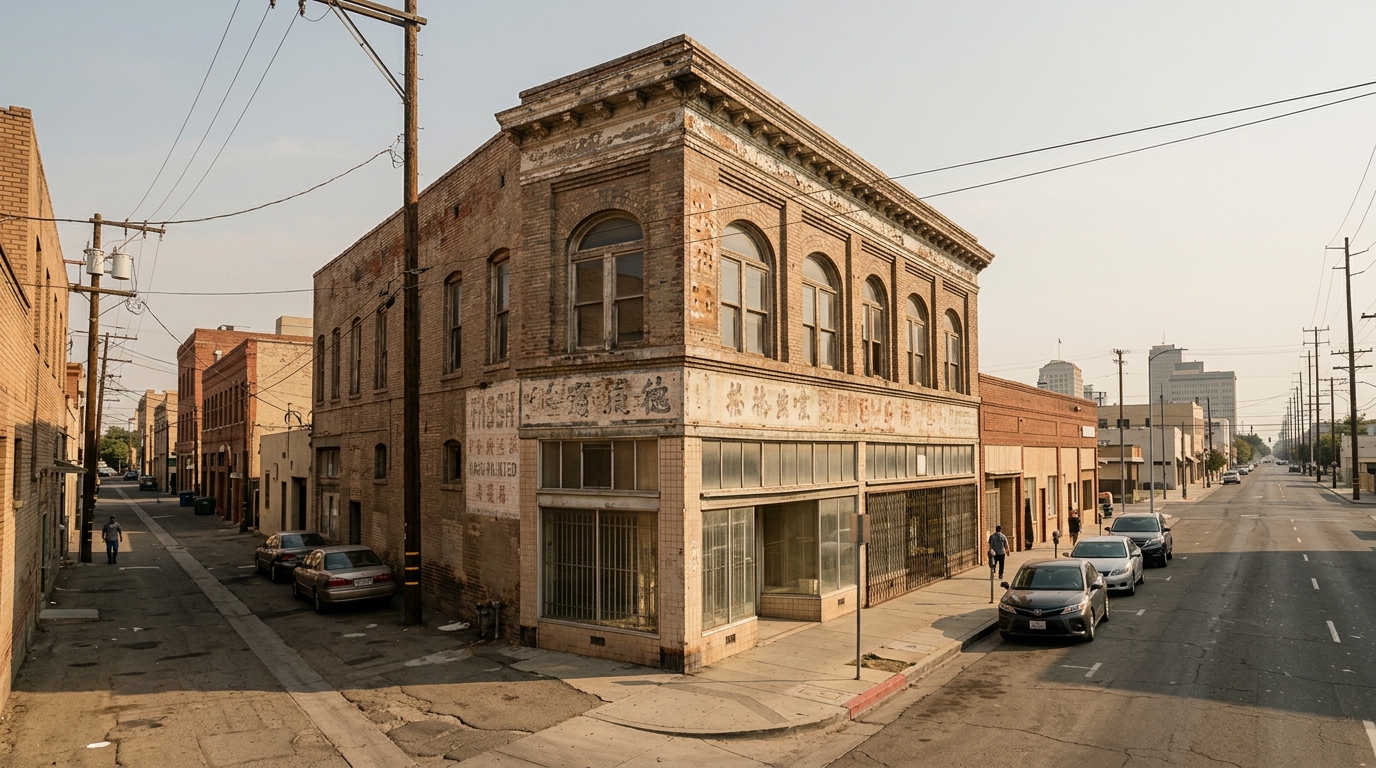
The Peacock Building Fresno 2026 debate has become one of the city’s most interesting preservation stories this fall. On September 28, Fresno’s Historic Preservation Commission considered whether the property at 937–945 F Street and 942 Fagan Alley should qualify for the city’s Local Register of Historic Resources.
The vote matters because the property sits inside Fresno’s historic Chinatown and is also connected to a planned housing redevelopment. That puts several important goals in the same place: preserving community history, addressing deteriorated buildings, and creating new housing near Downtown.
The story becomes even more complicated when the building’s past is considered. The main F Street structure dates to about 1907. Over more than a century, it housed shops, restaurants, hotel rooms, immigrant-owned businesses, and eventually the Peacock Department Store.
City staff recommended that the Historic Preservation Commission find the property ineligible for local historic listing. Professional studies cited extensive alterations and loss of historic integrity. Yet the Commission approved the September action item by a 3–2 vote.
That disagreement makes the Peacock Building an important case study. It raises a larger question Fresno will continue to face: how should a city value a place whose physical fabric has changed, but whose community history remains meaningful?
Why the Peacock Building Fresno 2026 Debate Is About More Than Architecture
The property stands on F Street between Tulare and Kern streets in Fresno’s Chinatown. The neighborhood developed west of the railroad tracks and became home to communities that often faced exclusion from other parts of the growing city.
Fresno’s Chinatown history includes Chinese, Japanese, Armenian, Mexican, and other immigrant communities. Businesses, lodging houses, restaurants, social organizations, and family enterprises created a district with a character different from the commercial core east of the tracks.
The Peacock Building reflects several layers of that history.
Its current appearance is not the appearance it had in 1907. Storefronts changed. Additions appeared. A major 1950s remodel gave the building a more Modern look. Later repairs and deterioration changed it again.
Those changes are central to the current preservation debate because historic designation usually considers both significance and physical integrity.
From a 1907 Commercial Block to a Chinatown Department Store
Historical research says Choi Men acquired the property in 1907. Records connect the site with the Tuck On Jan Company, which was purchasing land in Chinatown during a period when members of Fresno’s Chinese community sought greater control over their commercial property.
A brick commercial building was constructed on F Street soon afterward. By 1918, maps show several businesses at street level. The uses included retail shops, a restaurant, and even a shooting gallery.
The second floor served a different role. It contained furnished rooms or hotel accommodations.
This mixture of commerce and lodging was common in early twentieth-century urban districts. A building could support businesses during the day while providing housing above them.
The addresses 937, 939, 941, 943, and 945 F Street were all associated with the structure. Different tenants used these spaces over the decades.
That history helps explain why the building cannot be understood through one storefront alone.
The Mar Family Turned 945 F Street Into a Long-Running Local Business
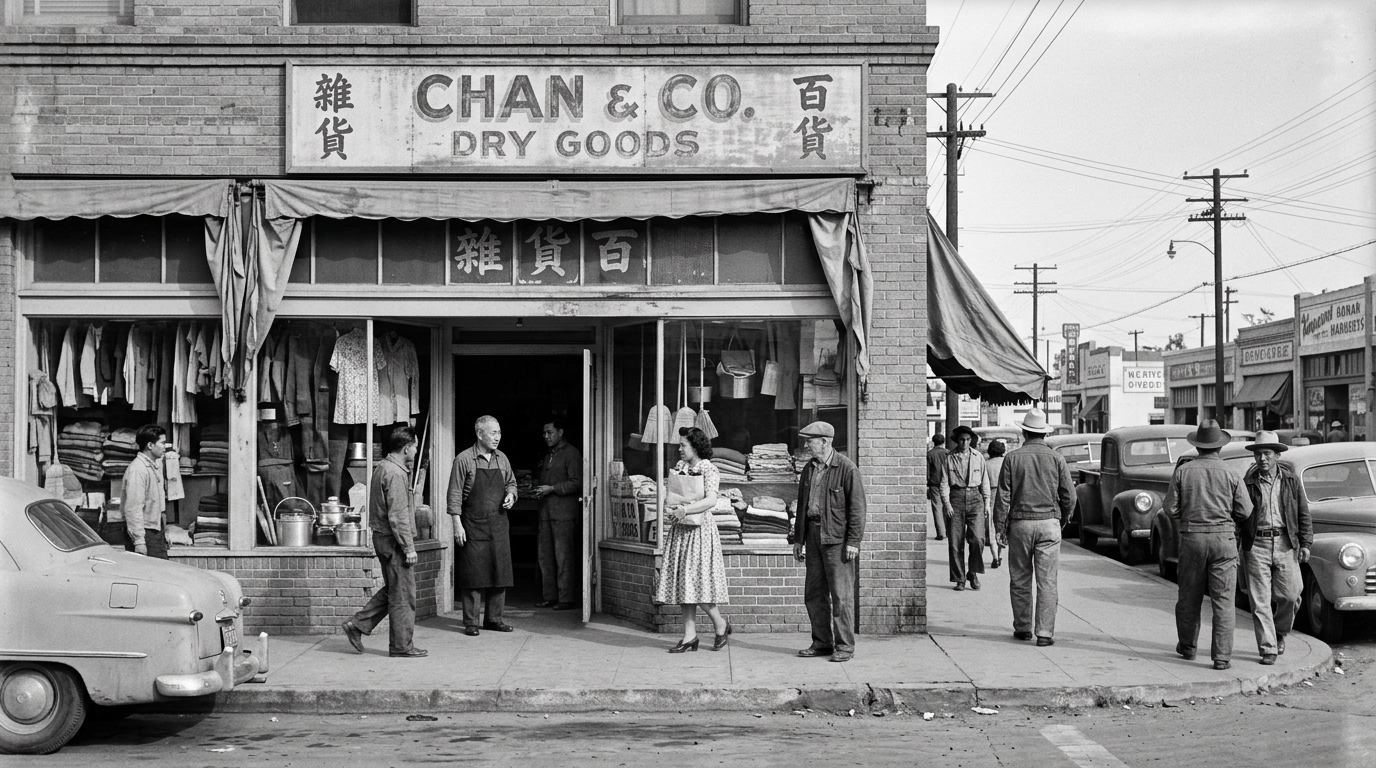
A major chapter began in 1932 when Allen C. Mar Sr. opened a dry goods store at 945 F Street.
Mar had immigrated from China during the early twentieth century. He worked in agriculture before he and his wife, Jessie, gained enough resources to establish their own business.
As the store grew, the Mar family acquired more of the building. They also lived behind the commercial space while raising their family.
Jessie Mar became notable beyond the store itself. Historical research connects her with fundraising campaigns and several community organizations. She served as president of the Loc Kwun Association and as secretary of the Chinese Consolidated Benevolent Association.
Those organizations helped preserve Chinese culture and supported the interests of Fresno’s Chinese-American community.
This personal history gives the Peacock Building a connection to the wider story already explored in our Fresno Chinatown preservation guide. Chinatown’s importance comes from both buildings and the communities that used them.
The 1950s Remodel Became Part of the Building’s Own History
During the 1950s, the family renamed the business Peacock Department Store.
The change came with a major renovation. Storefronts were altered, the façade gained a more Modern appearance, and a new marquee and Peacock sign appeared.
This creates an unusual preservation question.
Alterations can weaken a building’s ability to represent its original construction period. Yet an old alteration can eventually become historically interesting in its own right.
By the mid-twentieth century, the Peacock was no longer simply an early brick commercial block. It had become a modernized Chinatown department store connected with the Mar family’s long business history.
Later changes continued. The store eventually focused more heavily on men’s clothing under Allen Mar Jr. and his wife, Anna.
Allen Mar Jr. also took part in civic and community life. His roles included service with local commissions, merchant groups, and Chinese-American organizations.
The building therefore represents several periods rather than one untouched moment in time.
Why the September 28 Historic Preservation Vote Matters
Fresno purchased the property in October 2025 with the goal of clearing the site for an affordable-housing project.
Earlier environmental documents describe a possible four-story mixed-use building with as many as 100 residential units and ground-floor commercial space. Those documents describe a planning concept, not a guarantee that the final project will contain exactly 100 homes.
Before redevelopment moves forward, the City has had to study cultural resources and the historical importance of the existing buildings.
The September hearing became important because professional evaluations and the Historic Preservation Commission did not arrive at the same conclusion.
City Staff Recommended Ineligibility, but the Commission Voted Differently
City staff recommended finding the Peacock property ineligible for Fresno’s Local Register.
The staff report relied on several historical evaluations. Those studies concluded that years of alterations had weakened the property’s historic integrity.
The reports also found that the building did not clearly meet the normal criteria for architectural significance, association with a major historic event, association with an individually significant person, or its ability to provide important new historical information.
A September 2026 review by Stantec reached a similar conclusion regarding individual eligibility for the National Register and California Register.
There was another concern. A structural assessment described extensive deterioration, mold, irregular repairs, and major challenges for adaptive reuse.
Despite those findings, the Historic Preservation Commission approved the September action item by a 3–2 vote.
That vote should not be simplified into a claim that every professional study suddenly changed its conclusion. Instead, it shows that preservation decisions can involve different interpretations of significance, community history, and local criteria.
The case also echoes the questions raised in our article about the former Fresno Bee Plant. A building can have a documented historical story while still facing serious questions about condition, reuse, and redevelopment.
What the Peacock Building Debate Could Mean for Fresno Chinatown
The immediate dispute concerns one property. The larger issue concerns how Fresno tells the history of Chinatown during a period of major change.
The City is already conducting a broader update of the Chinatown historic-resource survey. That work may help identify buildings, cultural themes, and possible district boundaries that earlier studies missed or interpreted differently.
This is important because traditional preservation systems often focus heavily on architecture.
Architecture matters, but some neighborhoods draw much of their significance from migration, small businesses, civil rights, family networks, labor, religion, and cultural organizations.
Physical buildings may change while those community stories remain historically important.
The Peacock case sits directly inside that discussion.
Fresno Must Balance Housing, Building Condition and Cultural Memory
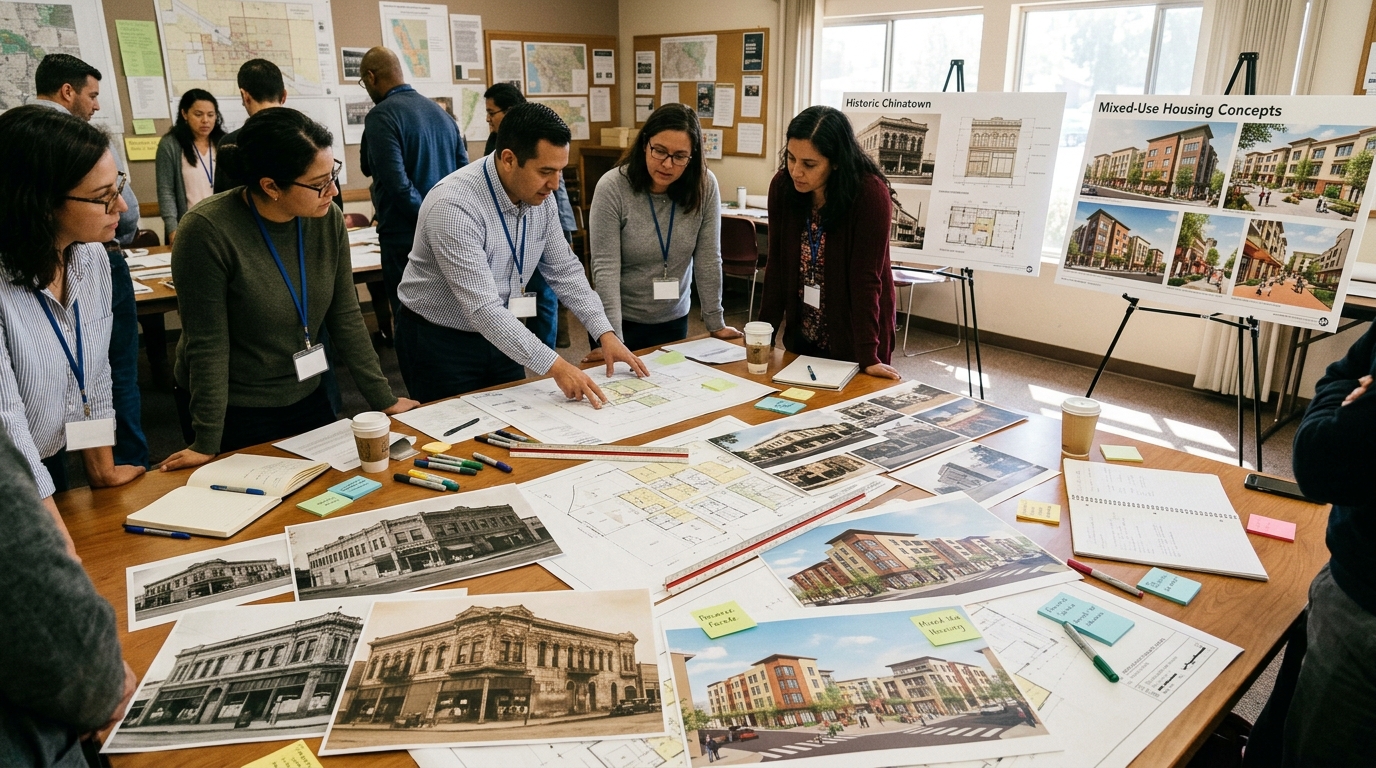
Preservation and housing are sometimes described as complete opposites. Real projects are usually more complicated.
Fresno needs housing. Chinatown also needs investment after decades of disinvestment and interrupted redevelopment efforts.
At the same time, removing too many surviving buildings can make it harder to understand why the neighborhood mattered in the first place.
Adaptive reuse can sometimes solve both problems. A historic structure may gain a new function while keeping important features.
That approach is being explored elsewhere Downtown. Our article on the former Berkeley’s Department Store shows how a mid-century commercial building may gain new restaurants, offices, and other uses instead of disappearing.
The Peacock Building presents a harder case. City documents describe poor structural conditions and limits on redesigning the interior because existing walls help support the structure.
That does not automatically settle the cultural question. It does show why preservation debates need more than nostalgia.
A responsible decision should consider history, engineering, cost, housing needs, archaeology, neighborhood context, and what parts of the story can realistically survive.
Watch the Local Register Process and the Wider Chinatown Survey Next
The September vote is an important milestone, but readers should continue watching the formal City process.
Fresno’s preservation ordinance involves both the Historic Preservation Commission and City processes for designation. A Commission action should not be confused with the completion of every future redevelopment or designation step.
The wider Chinatown survey may prove even more important in the long term.
That study can help answer whether individual properties should be viewed only as separate buildings or as parts of a larger cultural landscape.
Residents should also watch how the proposed housing project changes. Earlier environmental documents describe up to 100 residential units, but final design details can evolve.
Another issue is archaeology. Chinatown has a long history beneath the visible buildings. Cultural-resource reports note that excavation may encounter materials that are not visible at ground level.
For readers who want the broader context, our Historic Landmarks guide explains how Fresno’s buildings can act as records of changing civic, commercial, and residential life.
The Peacock Building Fresno 2026 debate matters because it forces Fresno to define what preservation means in a neighborhood that has already lost much of its original fabric.
The structure has changed many times since the early twentieth century. Those alterations weaken some traditional arguments for architectural integrity.
Yet the building is also tied to decades of Chinatown commerce, the Mar family, Chinese-American community organizations, lodging, retail, and the changing life of F Street.
Those two facts can exist at the same time.
The September 28 vote does not erase the engineering problems or guarantee that the existing structures will remain unchanged. It does show that the history of the property remains contested and significant enough to demand public attention.
As Fresno continues its Chinatown survey and housing plans, the Peacock Building offers a useful lesson. Historic preservation is not only about saving beautiful architecture. It is also about deciding which physical places help a city remember the people and communities that shaped it.
For the official September 28 hearing record, staff analysis, cultural-resource report, and structural documents, review the City of Fresno Historic Preservation Commission record for Item 26-1259.