
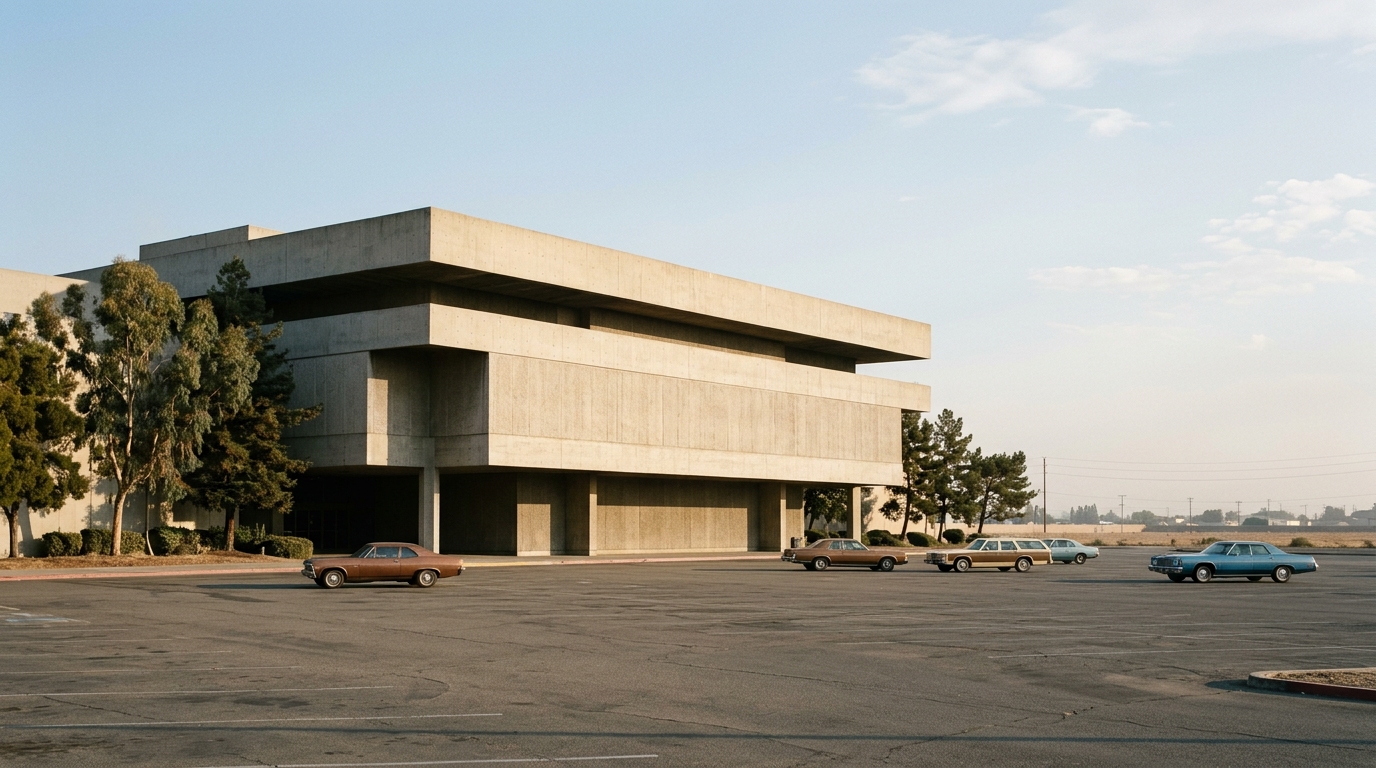
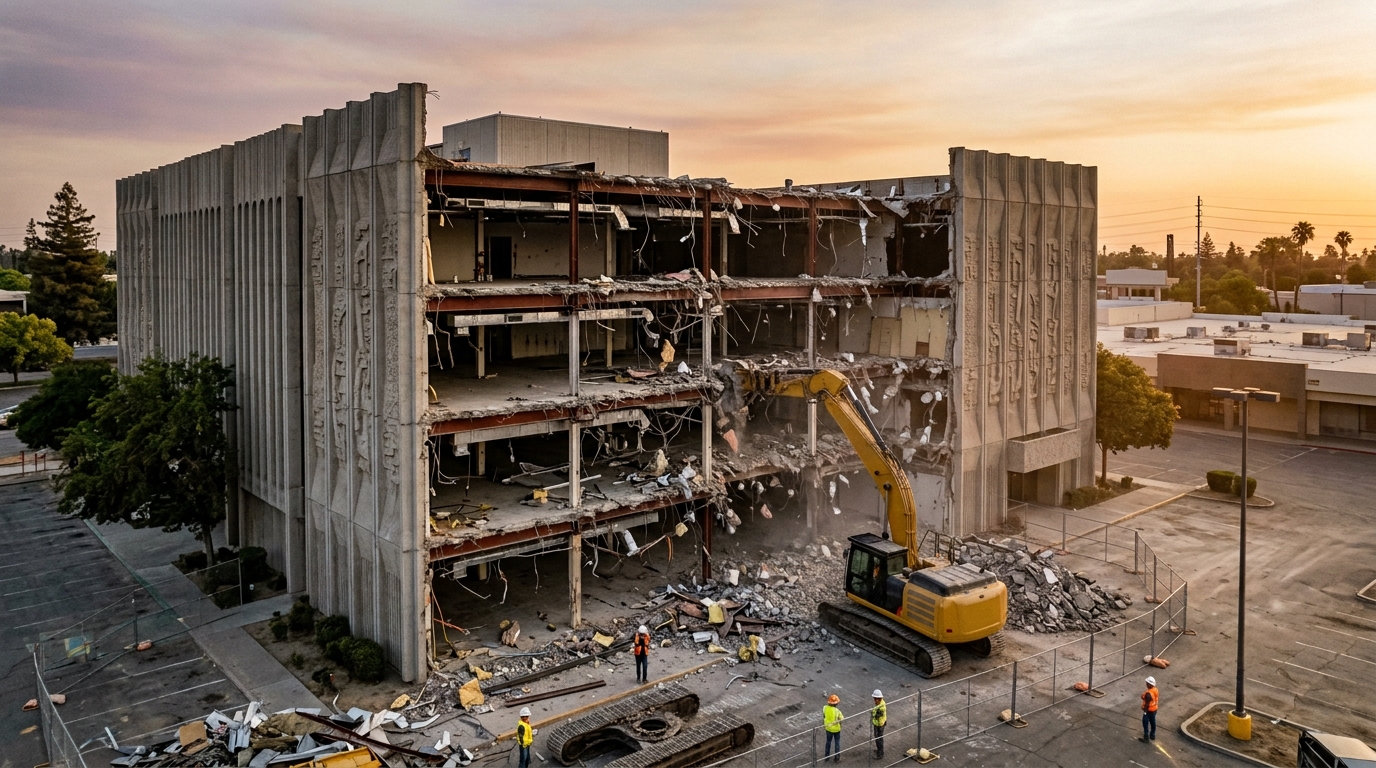
For more than half a century, the large department-store building at 755 E. Shaw Avenue marked the eastern end of Fashion Fair Mall. Generations of Fresno shoppers knew it first as Weinstock’s, later as Gottschalks, and most recently as Forever 21. In 2026, the building entered its final chapter. After a historic-resource review and a decision not to initiate local designation, demolition began to make way for a new retail project.
Built in 1970, the former Weinstock’s was a physical reminder of the period when Fresno’s commercial center of gravity was moving north from downtown toward suburban shopping centers. Its Late Modern design, open sales floors, climate-controlled interior, and place within Fashion Fair’s original anchor lineup reflected a new vision of shopping and city growth.
As of August 19, 2026, demolition was still underway and the former store was nearing complete removal. A large-format Dick’s House of Sport is planned for the site, with an anticipated opening in late 2027 or early 2028. That makes Weinstock’s a timely example of how quickly the architecture of Fresno’s recent past can move from familiar place to historical record.
How Weinstock’s Helped Define a New Era of Fresno Retail
Fashion Fair emerged during a major period of postwar expansion. City of Fresno research says development began after a 58-acre tract along Shaw Avenue between Fresno and First streets was purchased in 1965 for a regional shopping center. The project required rezoning and generated debate because it represented a major expansion of commercial activity away from Fresno’s traditional downtown core.
When Fashion Fair opened in 1970, three department stores helped anchor the new mall: Weinstock’s, Gottschalks, and JCPenney. The mix was revealing. Gottschalks had deep Fresno roots, while Weinstock’s was a Sacramento-based chain and JCPenney represented a national brand. Together, they established the mall as a regional destination.
The broader shift can be explored through our Fresno Timeline, which traces how transportation, suburban growth, housing, and commercial development changed the city’s geography.
Fashion Fair Helped Pull Shopping North
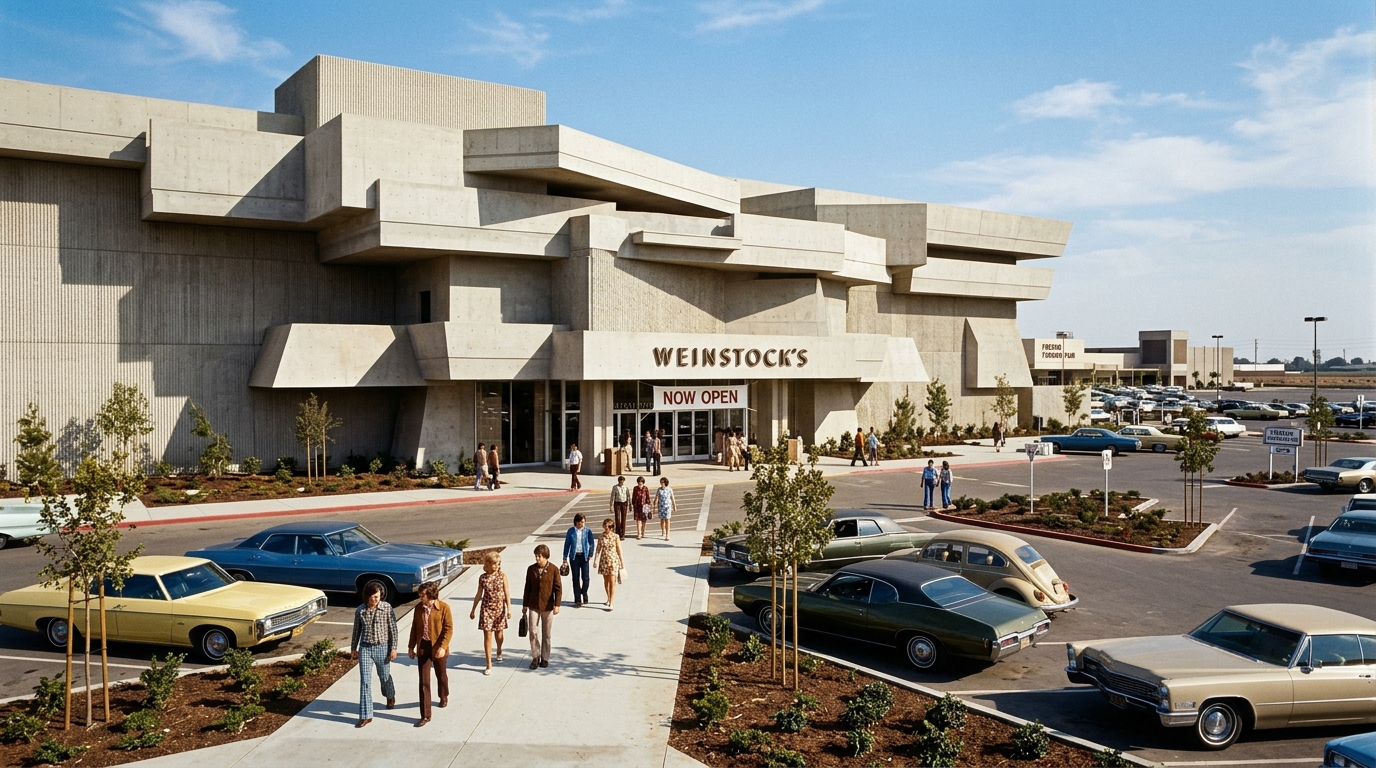
Downtown Fresno had long served as the city’s primary retail and civic center, but postwar development changed how residents moved through the city. Automobile ownership, suburban subdivisions, larger parking areas, and regional shopping centers allowed retail to follow population growth outward.
City preservation documents say Fashion Fair’s opening is widely associated with the northward migration of retail activity in Fresno. The 2026 historic evaluation, however, rejected the idea that Weinstock’s alone caused downtown’s decline. Fashion Fair was part of a much larger commercial transformation.
That transition provides a useful contrast with our article on Downtown Fresno revitalization and historic buildings, where the challenge today is bringing housing, businesses, and activity back into the older urban core.
An $8 Million Late Modern Store Opened in 1970
Weinstock’s opened on August 31, 1970, at a reported construction cost of $8 million. It was designed by Charles Luckman Associates of Los Angeles, with Richard McKnew identified as project architect. The firm was associated with major twentieth-century commercial projects across the United States.
The store was promoted as technologically advanced. Steel-frame construction created broad interior areas with fewer columns, while the building was climate controlled. Its exterior used projecting horizontal levels and planes that created changing patterns of sunlight and shadow.
Fresno’s 2026 review characterized the building as Late Modern. The style developed from the modern movement of the 1960s and 1970s and often emphasized sculptural massing, bold geometry, and strong structural expression. Readers interested in Fresno’s changing architectural landscape can also visit our Historic Landmarks section.
From Weinstock’s to Gottschalks to Forever 21
The building survived several changes in retail identity. Weinstock’s occupied it first. After corporate changes in the 1990s, Gottschalks took over the space. Following Gottschalks’ bankruptcy, Forever 21 became the most recent major tenant.
An extensive remodel in 2010 and 2011 accompanied Forever 21’s move into the property. The main entrance became a double-height glazed opening, secondary entrances changed, and other alterations accumulated over time. Despite those modifications, City staff noted that much of the exterior still retained its original character when the demolition application prompted a historic review.
Why the Building Was Reviewed Before Demolition
The former Weinstock’s had stood for more than 50 years, so the demolition application raised the question of whether it might qualify for Fresno’s Local Register of Historic Resources. The Historic Preservation Commission considered the property in early 2026.
A Historic Resource Evaluation prepared by Page & Turnbull concluded that the building did not meet the necessary significance criteria for local or California Register eligibility. In March, the commission affirmed that finding in a 5-1 vote, clearing the way for demolition.
Why the Commission Declined Historic Designation
The evaluation did not say the building lacked history. Instead, it asked whether the property was significant enough to meet formal designation criteria. Under the event criterion, the report found that Weinstock’s was one of three original Fashion Fair anchors and was not individually responsible for retail’s shift away from downtown.
Under the architecture criterion, evaluators noted that Charles Luckman Associates used related designs for other Broadway-Hale department stores and concluded that Fresno’s example was not a sufficiently distinguished or unique work of the firm. The report also found no strong association with a historically significant person and no archaeological potential that would meet the other criteria.
That distinction matters: a building can be old, familiar, architecturally interesting, and meaningful to residents without satisfying the standards required for formal historic designation. A similar question appears in our article about the former Fresno Bee Plant.
What the Demolition Teaches Us About Fresno’s Recent Past
The demolition of Weinstock’s raises a broader question for Fresno history: when does everyday architecture become heritage?
Buildings from the 1960s and 1970s can be difficult to evaluate because many residents remember them in active use. They may feel too familiar or too recently outdated to be considered historic. Yet the National Park Service notes that mid-century commercial buildings can reveal major changes in construction, design, marketing, transportation, and consumer culture.
Its discussion of mid-century commercial modernism explains that ordinary banks, shops, cinemas, and similar buildings were often among the first expressions of modern design encountered by local communities. Many have disappeared before their significance was fully recognized.
The 1970 Time Capsule Will Outlive the Building
One physical piece of the original store has survived demolition: a time capsule installed during construction on June 26, 1970. A plaque directed that it be opened one century later.
When demolition began in summer 2026, crews safely removed the capsule before the building came down. Mall management secured it, and it is scheduled to remain sealed until 2070. The symbolism is striking: the building surrounding the capsule will not reach its centennial, but the object placed there specifically to communicate with future Fresno residents still may.
The capsule connects the optimism surrounding Fashion Fair’s construction in 1970 with a future generation that may experience the site in a completely different form. Our Photo Archive can serve a similar purpose by preserving images of places that future residents may no longer see in person.
Documenting Ordinary Places Before They Disappear
Not every building can be saved, and historic preservation cannot mean declaring every structure older than 50 years a landmark. But demolition makes documentation more important.
Photographs of the Weinstock’s facade, architectural drawings, newspaper advertisements, construction records, employee memories, and images of Fashion Fair’s early years can preserve the story after the building is gone. The 2026 historic evaluation itself is now part of that record because it documents the store’s design, construction, alterations, architects, and relationship to mall development.
This is why Fresno’s broader surveys matter. Our article on the Tower District preservation plan explains how updated research can identify buildings and cultural histories before development pressure forces fast decisions.
By August 2026, the former Weinstock’s was nearing the end of demolition, and Fashion Fair was preparing for another retail era. The new House of Sport will bring a very different kind of large-format shopping experience to the same end of the mall. That cycle—construction, success, adaptation, vacancy, demolition, and replacement—is itself part of Fresno history.
The lesson is not that the 1970 building necessarily should have been designated. The professional evaluation and Historic Preservation Commission reached the opposite conclusion. The more useful lesson is that the recent past deserves serious attention before its physical evidence disappears.
For decades, Weinstock’s was simply a place to shop. Today, as its walls disappear, it is easier to see the building as evidence of how Fresno changed in 1970. By 2070, when the time capsule is scheduled to be opened, the store may be remembered mainly through photographs, reports, and the stories residents preserve. What seems commonplace in one generation can become essential historical evidence for the next.